Large Format Additive Manufacturing
Robotic Polymer Extrusion for Architectural Components and Hybrid Assemblies
OVERVIEW | OBJECTIVES
Large Format Additive Manufacturing research at Hi-DARS Lab investigates how robotic polymer extrusion can contribute to architectural systems through the coordination of component geometry, material behavior, and assembly. Working with Caracol AM’s Heron High Versatility platform, the lab develops printed components in relation to the timber, ceramic, and mechanical elements with which they are assembled.
Across the Discrete Hybrid Vault, Cellular Dwelling, and Flex Camp, fabrication experience informs decisions about geometric complexity, subdivision, and connections. Differences observed between PETG and ASA establish material-specific considerations, including the potential for smaller, simpler ASA components to form larger dry-assembled systems with timber.
The research connects computational modeling, slicing, robotic production, and physical assembly through an iterative workflow. Observations from fabrication and component fit inform subsequent design revisions, supporting the development of repeatable methods that respond to the material and operational conditions of large-format printing.
INTEGRATED DESIGN-TO-ASSEMBLY WORKFLOW
Computational geometry and component subdivision.
Slicing, toolpath preparation, and printing orientation.
Robotic extrusion of PETG and ASA components.
Coordination with timber, ceramics, and mechanical connections.
Physical assessment of print quality, component fit, and assembly.
Revision of geometry and production strategies through fabrication feedback.
Research Scope
Connecting Material Behavior with Architectural Assembly
The research brings together material experimentation, computational development, and architectural prototyping. Component geometry is developed in relation to how a part will be printed, handled, connected, and positioned within a larger system.
A central question is how fabrication constraints can inform the organization of architectural assemblies. Decisions about component size, surface complexity, and subdivision affect both production and the connections required between parts. The work examines these relationships through graduate research and design studio projects, connecting robotic fabrication with hands-on assembly.
Robotic Polymer Extrusion
Caracol Heron High Versatility Platform
Hi-DARS Lab uses the Caracol Heron High Versatility platform for robotic large-format polymer extrusion. The system combines robotic motion with pellet-based extrusion to produce components for architectural prototyping.
From August 2025 to August 2026, the lab used Eidos for slicing and production preparation, including the Discrete Hybrid Vault, Cellular Dwelling, and Flex Camp projects. The lab has since transitioned to Eidos Builder for ongoing slicing and fabrication work.
The documented production uses PETG for black printed components and ASA for white components. Their different responses during fabrication provide a basis for investigating material-specific approaches to geometry, printing, and assembly.
Parametric Design + Toolpath Development
Rhinoceros and Grasshopper support the development of component geometry, subdivision, and assembly relationships. For the three documented projects, slicing was carried out in Eidos to prepare the geometry for robotic production.
The workflow considers planar and non-planar deposition in relation to surface geometry, printing orientation, and toolpath continuity. Robotic reach and nozzle clearance are considered alongside the interfaces between printed components and adjacent materials.
Physical production provides feedback for computational development. Printing and assembly observations inform revisions to component boundaries, geometric transitions, and connection details, keeping fabrication decisions connected to the overall architectural system.
Material Behavior + Fabrication Trials
Geometry as a Production Variable
Fabrication trials revealed differences between PETG and ASA. In the lab’s experience, PETG exhibited greater flexibility and was generally easier to work with during production. ASA showed delamination when printing more complex geometries, while smaller components with simpler geometries remained intact and performed more consistently during handling and assembly.
These observations informed decisions about which geometries to print as continuous parts and where to divide larger forms. Component size and complexity became practical considerations in coordinating material selection with printing and assembly strategies.
The trials suggest that larger architectural systems can be developed by coordinating manageable printed parts with timber elements. Within this approach, the printed components can be shaped around specific interfaces and fabrication requirements, while their assembly with timber establishes the larger configuration..
Research Scope
Connecting Material Behavior with Architectural Assembly
The research brings together material experimentation, computational development, and architectural prototyping. Component geometry is developed in relation to how a part will be printed, handled, connected, and positioned within a larger system.
A central question is how fabrication constraints can inform the organization of architectural assemblies. Decisions about component size, surface complexity, and subdivision affect both production and the connections required between parts. The work examines these relationships through graduate research and design studio projects, connecting robotic fabrication with hands-on assembly.
Robotic Polymer Extrusion
Caracol Heron High Versatility Platform
Hi-DARS Lab uses the Caracol Heron High Versatility platform for robotic large-format polymer extrusion. The system combines robotic motion with pellet-based extrusion to produce components for architectural prototyping.
From August 2025 to August 2026, the lab used Eidos for slicing and production preparation, including the Discrete Hybrid Vault, Cellular Dwelling, and Flex Camp projects. The lab has since transitioned to Eidos Builder for ongoing slicing and fabrication work.
The documented production uses PETG for black printed components and ASA for white components. Their different responses during fabrication provide a basis for investigating material-specific approaches to geometry, printing, and assembly.
Parametric Design + Toolpath Development
Rhinoceros and Grasshopper support the development of component geometry, subdivision, and assembly relationships. For the three documented projects, slicing was carried out in Eidos to prepare the geometry for robotic production.
The workflow considers planar and non-planar deposition in relation to surface geometry, printing orientation, and toolpath continuity. Robotic reach and nozzle clearance are considered alongside the interfaces between printed components and adjacent materials.
Physical production provides feedback for computational development. Printing and assembly observations inform revisions to component boundaries, geometric transitions, and connection details, keeping fabrication decisions connected to the overall architectural system.
Material Behavior + Fabrication Trials
Geometry as a Production Variable
Fabrication trials revealed differences between PETG and ASA. In the lab’s experience, PETG exhibited greater flexibility and was generally easier to work with during production. ASA showed delamination when printing more complex geometries, while smaller components with simpler geometries remained intact and performed more consistently during handling and assembly.
These observations informed decisions about which geometries to print as continuous parts and where to divide larger forms. Component size and complexity became practical considerations in coordinating material selection with printing and assembly strategies.
The trials suggest that larger architectural systems can be developed by coordinating manageable printed parts with timber elements. Within this approach, the printed components can be shaped around specific interfaces and fabrication requirements, while their assembly with timber establishes the larger configuration.
Architectural Applications
From Printed Components to Coordinated Assemblies
Discrete Hybrid Vault
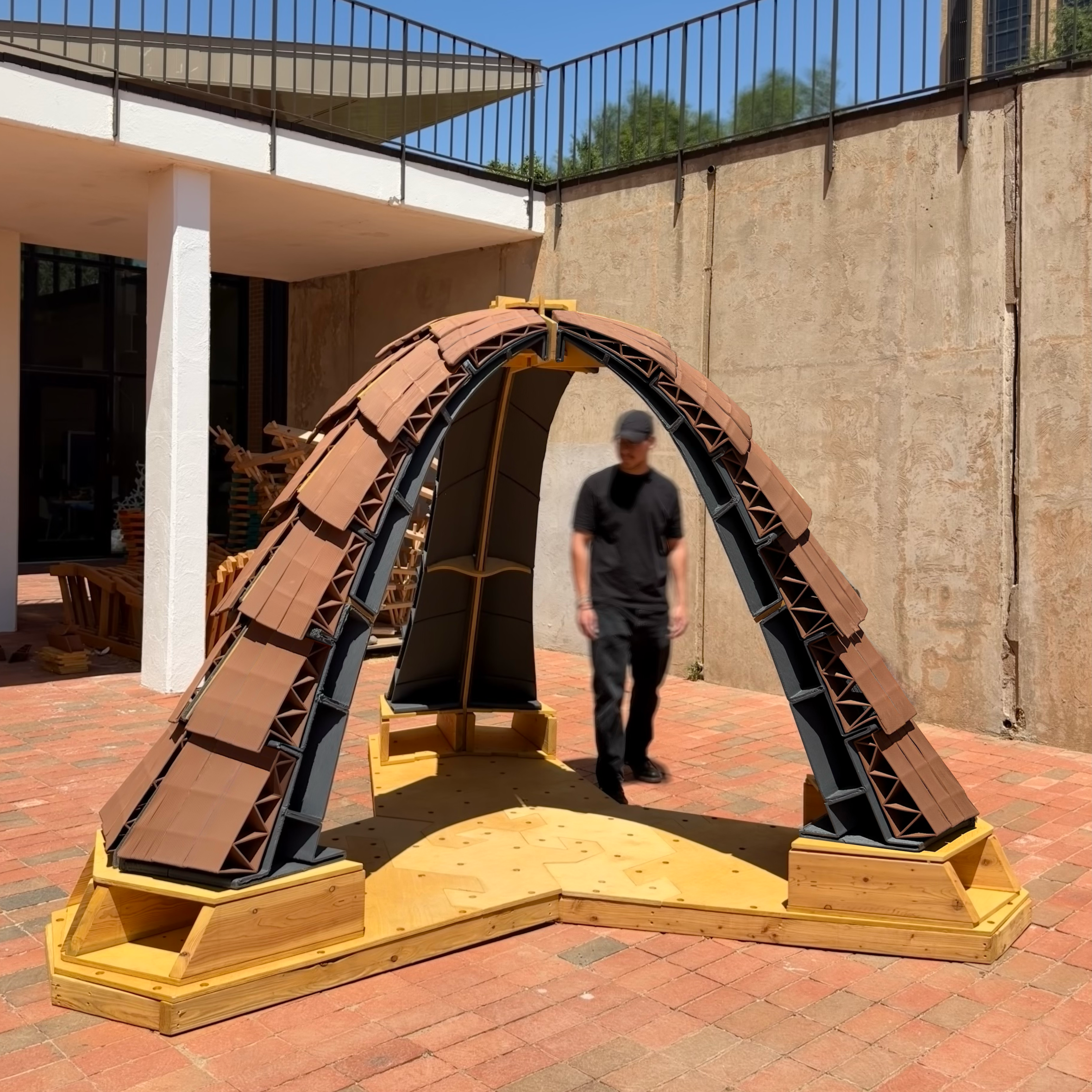
The Discrete Hybrid Vault investigates non-planar LFAM through a thrust-network-derived tripartite geometry divided into twelve primary shell components, with additional base and interface elements. The fabricated LFAM vault demonstrates assembly feasibility and self-support under its own weight.
The hybrid system integrates glass-fiber-reinforced PETG, printed Cinco Rojo ceramics, CNC-milled timber, and mechanical hardware. Timber members register and align components, while removable connections accommodate replacement. The work connects geometric discretization and printing orientation with dimensional fit and assembly requirements.
Cellular Dwelling
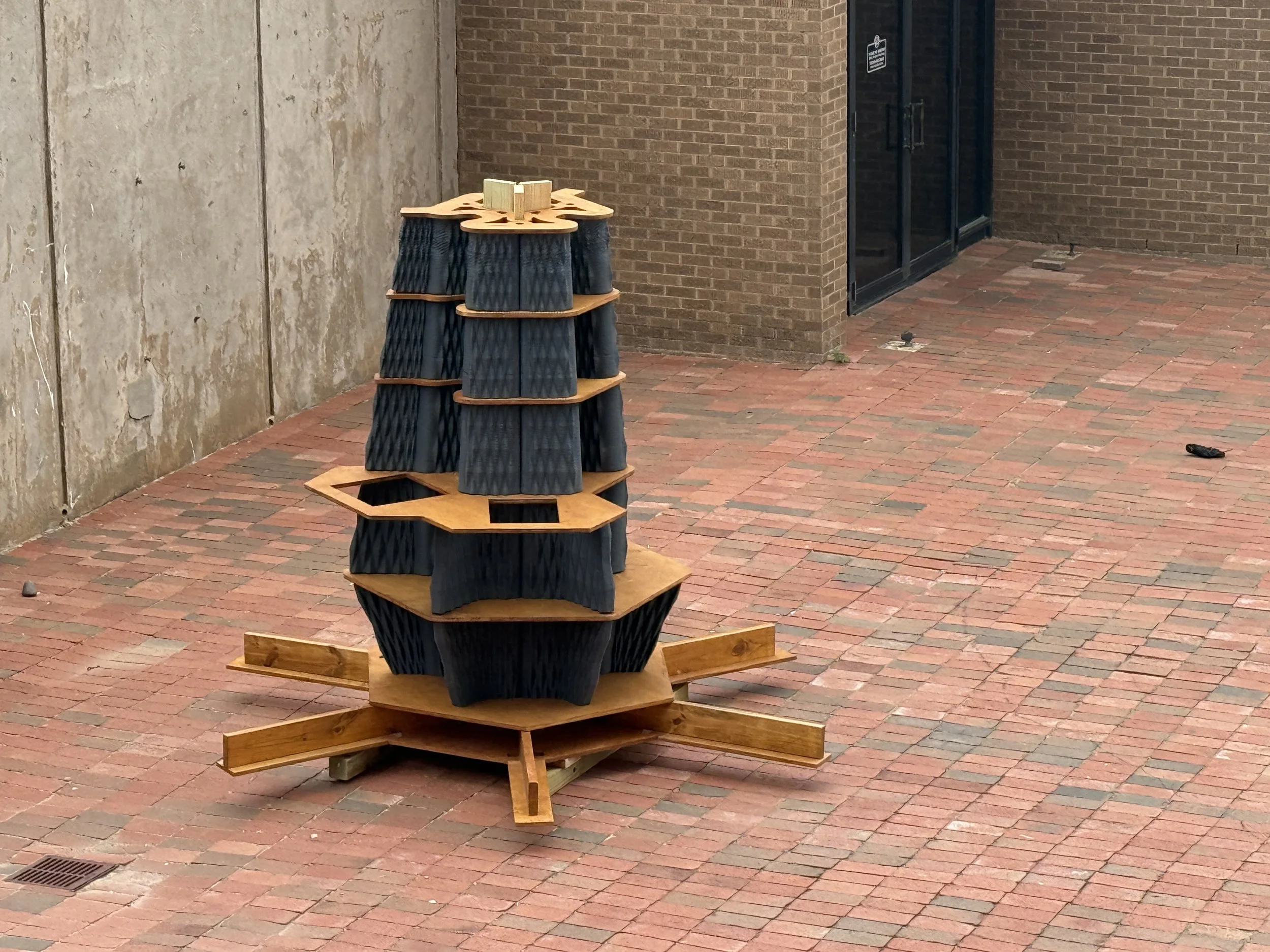
Developed within the Spring 2026 Live in Motion studio, Cellular Dwelling explores modular housing for seasonal ranch workers. Its full-scale prototype combines LFAM-printed core layers with CNC-milled birch plywood connectors.
The project coordinates additive and subtractive fabrication through a kit of parts and a defined assembly sequence. It provides an application of LFAM in which printed geometry is developed alongside the connections needed to construct a larger modular system.
Flex Camp
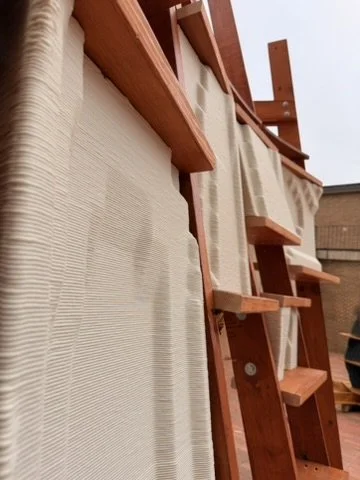
Also developed within Live in Motion, Flex Camp explores modular lodging through a full-scale module combining dimensional lumber with printed façade panels. Geological references inform the panels’ texture, depth, and surface articulation.
The project applies LFAM to a repeatable and replaceable enclosure system. Panel geometry and installation connect the printed surfaces with a timber framework, extending the research into material expression and hybrid construction.
Fabrication Outcomes + Future Development
The projects establish different roles for printed components within architectural systems, including vault segments, modular core layers, and enclosure panels. Across these applications, physical production informs how components are divided, connected, and assembled.
The material trials indicate that geometric complexity and component organization should be considered alongside material selection early in design. The observed differences between PETG and ASA provide a basis for more systematic investigation of print consistency, delamination, and dimensional variation.
Further development will focus on the relationship between printed components and larger dry-assembled systems. Comparisons of component geometry, printing orientation, and deposition settings can help clarify fabrication limits, while investigation of printed-to-timber interfaces can address installation tolerances, connection behavior, and repeated assembly.
The broader objective is to develop adaptable design-to-production methods in which computational geometry, material behavior, robotic constraints, and assembly requirements inform one another.
PUBLICATION | RECOGNITION
Recognition:
Discrete Hybrid Vault
Principal Investigators: Mark Segovia, Dr. Sina Mostafavi, Erin Hunt
Hi-DARS Team: Uijin Lee, Akhil Polimera.
Cellular Dwelling
Principal Investigatorl: Dr. Sina Mostafavi
Project Team: Maisie Munoz, Max Martin, Cameron Johnson, Aaron Delgadilo
Spring 2026 Studio | Live in Motion.
Flex Camp
Principal Investigator: Dr. Sina Mostafavi
Project Team: Susana Brinez, John Burgan, Connor Hathaway, Jeeseong Park
Spring 2026 Studio | Live in Motion.
Industry Collaboration
Caracol AM
Publications:
Non-Planar 3D Printing of Vaulted Structures: Using Variable Feed and Extrusion Rates for Wind-Informed Climate Resilience: Segovia, M. A., Rodriguez, D., Hunt, E., & Mostafavi, S. (2025). Non-planar 3D printing of vaulted structures: Using variable feed and extrusion rates for wind-informed climate resilience. In Computing for Resilience: Proceedings of the 45th Annual Conference of the Association for Computer Aided Design in Architecture (ACADIA 2025) (Vol. 2, pp. 86–101). ACADIA. https://doi.org/10.52842/conf.acadia.2025.2.086
Integrated Design-to-Production of Tripartite Hybrid Vault Structures Using Non-Planar Large-Format Additive Manufacturing: Forthcoming paper, IASS–IWSS 2026.
Non-Planar Large-Format Additive Manufacturing of Hybrid Vault Systems: Robotic Fabrication and Ceramic 3D Printing: Forthcoming special-session contribution, essay and poster, ROB|ARCH 2026.
Hybrid Vault: A Multi-Scale Fabrication- and Assembly-Aware Workflow for Discrete Construction Integrating Subtractive Methods, Ceramic 3D Printing, and Large-Format Additive Manufacturing: Forthcoming peer-reviewed paper, ACADIA 2026.
INFORMATION | CREDITS
Principal Investigators:
Sina Mostafavi, Ph.D. (PI)
Texas Tech University Hi-DARS Team:
Masie Munoz, Tahmures Ghiyasi
TTU HCoA Additional Support:
TTU-HCoA : Technology Course | First Last name